What an FBO does—and what it does not
A fixed-base operator, usually shortened to FBO, provides airport-based services that may include passenger facilities, fuel, aircraft parking, hangar space and handling. The term is particularly familiar in North American business aviation, but service descriptions and commercial structures vary internationally. A dedicated business aviation terminal may offer a similar passenger experience while using different terminology and subcontracting arrangements.
The FBO is not automatically the aircraft operator, the airport owner or a border authority. Signature Aviation and Atlantic Aviation are real examples of organisations associated with FBO services; mentioning them does not indicate that either is present at every airport or suitable for every mission. Ask which location will handle your flight and which services that specific location actually provides.
Before the aircraft arrives
The operator or its appointed trip-support team normally coordinates the handling request. Depending on the airport, that can involve parking confirmation, prior permission, slot coordination, fuel arrangements and passenger details. Availability should not be assumed merely because a runway appears on a map. Parking can be constrained during major events, and an airport may accept a landing without being able to accommodate a long stay.
Teterboro Airport, Farnborough Airport and Paris–Le Bourget Airport are established business aviation locations, but their procedures are not interchangeable. Local restrictions, published operating information and current conditions determine what is possible. Your practical question is whether the proposed arrival, departure and ground stay have been checked—not whether an airport is generally described as “private-jet friendly.”
Passenger reception is part of a regulated journey
Before travel, obtain the exact terminal or FBO address and a contact method for arrival-day coordination. A large airport may have several handling facilities on different sides of the airfield. A driver following the main passenger-terminal signs can take you to the wrong place. Confirm the expected arrival time with the operator rather than adopting a universal rule about how late private passengers can arrive.
Passports, immigration permissions, customs declarations and applicable security checks still matter. A private terminal can change the location and flow of a process; it does not erase the process. In the United States, U.S. Customs and Border Protection and the Transportation Security Administration have distinct responsibilities. The crew or operator should explain the requirements relevant to your route and passenger circumstances without promising exemption from official checks.
On the apron, coordination comes first
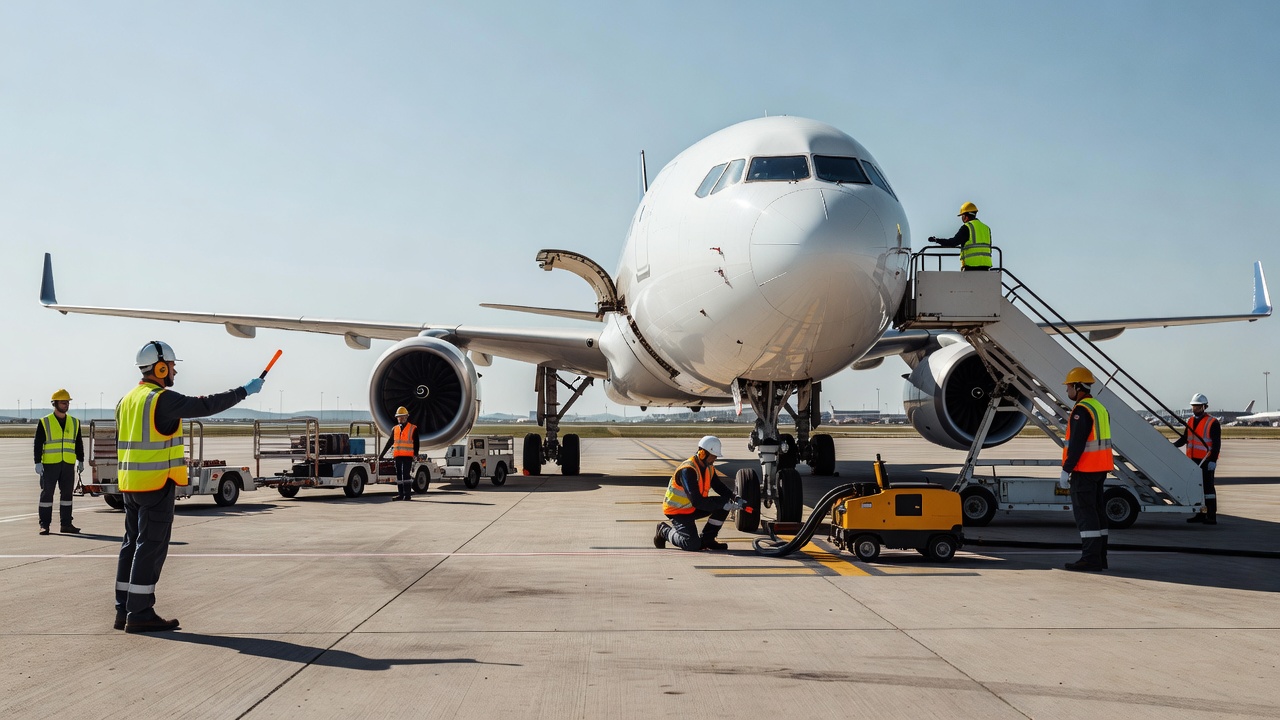
Aircraft handling may include marshalling, towing, baggage transfer, servicing and ground-power provision. Fuelling involves its own procedures and coordination with the crew. Passengers should follow staff instructions and avoid walking independently around aircraft, vehicles or equipment. A photograph, a phone call or a short cut across the apron is not worth distracting from the movement rules that keep people separated from hazards.
Baggage information belongs in the planning stage, especially for rigid cases, sports equipment, wheelchairs or unusually heavy items. Cabin volume and aircraft loading limits are different questions. A bag that fits through a door may still create a loading issue when considered alongside passengers, fuel and other baggage. The operator and crew need accurate information early enough to evaluate the mission.
Ground support has limits and dependencies
Weather, de-icing demand, fuel availability and airport congestion can affect the sequence. A ground handler cannot override a crew decision, an airport closure or air traffic restrictions. Nor does a comfortable lounge guarantee that the aircraft is ready to depart. Good communication identifies the dependency, explains the next decision point and avoids offering a departure time that no responsible party can yet confirm.
Accessible travel needs particularly careful coordination. Explain mobility requirements, transfer preferences and equipment dimensions before the itinerary is confirmed. Ask about the entire route from vehicle to seat, not just whether the terminal has step-free access. Aircraft doors, stairs and cabin layouts differ, and local equipment may be limited. The right solution depends on the actual aircraft and airport facilities.
Understand standards and invoices
IBAC's IS-BAH programme provides an industry framework for business aircraft ground handling. It can help structure questions about procedures and safety management, but it is not a replacement for checking a location's capabilities. Ask whether a quoted standard applies to the actual station and service in question. General network branding should not stand in for site-specific information.
Finally, clarify who pays for handling, parking, passenger transport, catering and special assistance. Some services may be included in the charter price; others may be arranged separately or passed through after the trip. Keep one agreed coordination channel so that two parties do not independently order the same service. A simple written service list is often more useful than a broad promise that “everything is handled.”